Plus, a defense of the “worst song ever made”

View email in browser

Share with a friend

Hey there, 


Welcome back to another edition of Virginia Capital, Dogwood’s economic policy newsletter where workers come first. 


You can read Tuesday’s edition here. 


Today, I take a look at how a coalition of professors, students, and local leaders are standing up to the attacks on the state’s higher education system.


I offer my take on a new survey about US worker alienation, and I stand up for an earnest Obama-era song that took over the algorithm this week.

Michael O'Connor

Reporter, Dogwood

 
Rodney Nickens Jr.

(Michael O'Connor/Dogwood)

It may be summer in Virginia, but there’s a cold wind blowing from across the Potomac River and through the academic buildings at the state’s largest public university. 


That’s because, as one professor told me, the Trump administration’s multiple investigations into George Mason University (GMU) are having a chilling effect on academic freedom there. The investigations have targeted that oldest of right-wing obsessions, racial diversity and equity efforts, at George Mason and the University of Virginia. 


Former UVA president Jim Ryan felt forced to resign as the Trump administration mounted a pressure campaign that threatened the school’s federal funding. 


The George Mason community feared their school’s president would face a similar fate last week, but instead, the Board of Visitors voted for GMU President Gregory Washington to keep his job and gave him a raise. 


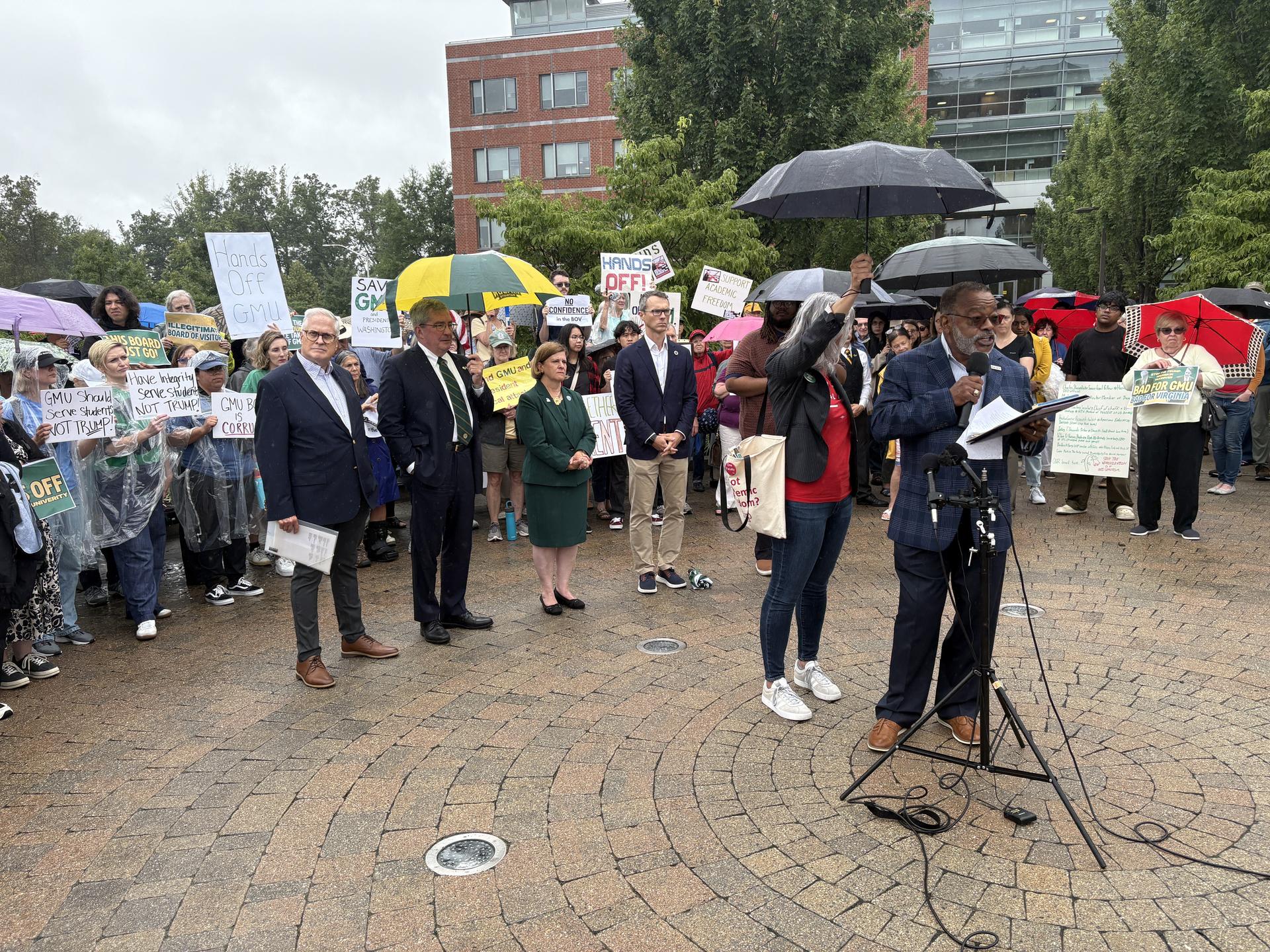
While the board was deliberating, a large crowd of Washington’s supporters made up of students, professors, a civil rights organization, labor groups, and elected officials rallied nearby in the rain.

A common theme for most every speaker that day was criticism of President Donald Trump and Virginia Gov. Glenn Youngkin for advancing political goals in places where the freedom of ideas is supposed to reign. 


“Our faculty are becoming afraid of getting in the crosshairs of the Department of Justice, and that is a direct violation of academic freedom,” Tim Gibson, who’s taught at George Mason for over 20 years, told me after the rally was over. “It chills our ability to teach the best that is thought and said in our disciplines.”


Gibson, who is active in the local chapter of the American Association of University Professors (AAUP), was the emcee of the rally, leading chants, introducing the speakers, and cracking jokes in between his Android phone locking up on him and his paper script getting destroyed in the rain. 


What’s striking to me about the advocacy of Gibson and professors like him is that they are sticking their necks out for bosses who they can’t meet with at the negotiating table. That’s because professors at public universities are state employees, and as such are legally not allowed to engage in collective bargaining or go out on strike. 


Gibson told me it was kind of ironic that professors like him were going to the mat for university leaders who were unlikely to return the favor. But it was important given how egregious the circumstances were. 


“What we're doing here is extremely important, because we're defending the mission of George Mason University,” Gibson said. 

You can read my coverage here.
 
  • Dave Ress at The Richmond Time-Dispatch has a report on Virginia’s low workers’ compensation rates. Of note: “Virginia is the only state where workers’ compensation insurance does not cover repetitive stress injuries.”


  • FFXnow’s Scott McCaffrey reports that the number of people in Fairfax County looking for a job is up by a third from the same time a year ago as the region reels from the Trump administration’s federal cuts.                              
  • The US Department of Veterans Affairs announced on Wednesday that it was moving to terminate collective bargaining agreements for more than 400,000 workers.     


(imgflip.com)

As if things weren’t bleak enough as it is, here’s a new Gallup report about the current mood in workplaces across the country: 


“U.S. employees remain emotionally detached from their workplaces, and most are still watching for their next opportunity.”


People hating their jobs isn’t exactly news, but we shouldn’t forget that it doesn’t have to be this way. 


The Gallup report goes on to explain that its survey found that just 32% of employees are engaged in their work, with employee engagement defined as “the involvement and enthusiasm of employees in both their work and workplace.”


Gallup’s measuring of employee engagement has been trending downward ever since the pandemic and the “Great Resignation” that followed.


Gallup’s survey respondents described isolated or impersonal workplaces, bad communication and transparency from management, and underinvestment in wages and development as contributing to their alienation. 


It’s telling that Gallup’s report has a section on how business leaders can respond, but no section for how employees themselves can respond.


It’s taken for granted that workers in the US have little to no agency and decisions about the workplace are ultimately in the hands of managers. 


But, as every worker knows, we do in fact know more about our work than our bosses do and the best way to address our alienation in the workplace is to make these spaces more democratic.


And arguably the best way to achieve greater democracy, and therefore greater engagement, in the workplace is with a union. 


(screenshot)

This week, my timeline was filled with all manner of takes on music from the 2010s. 


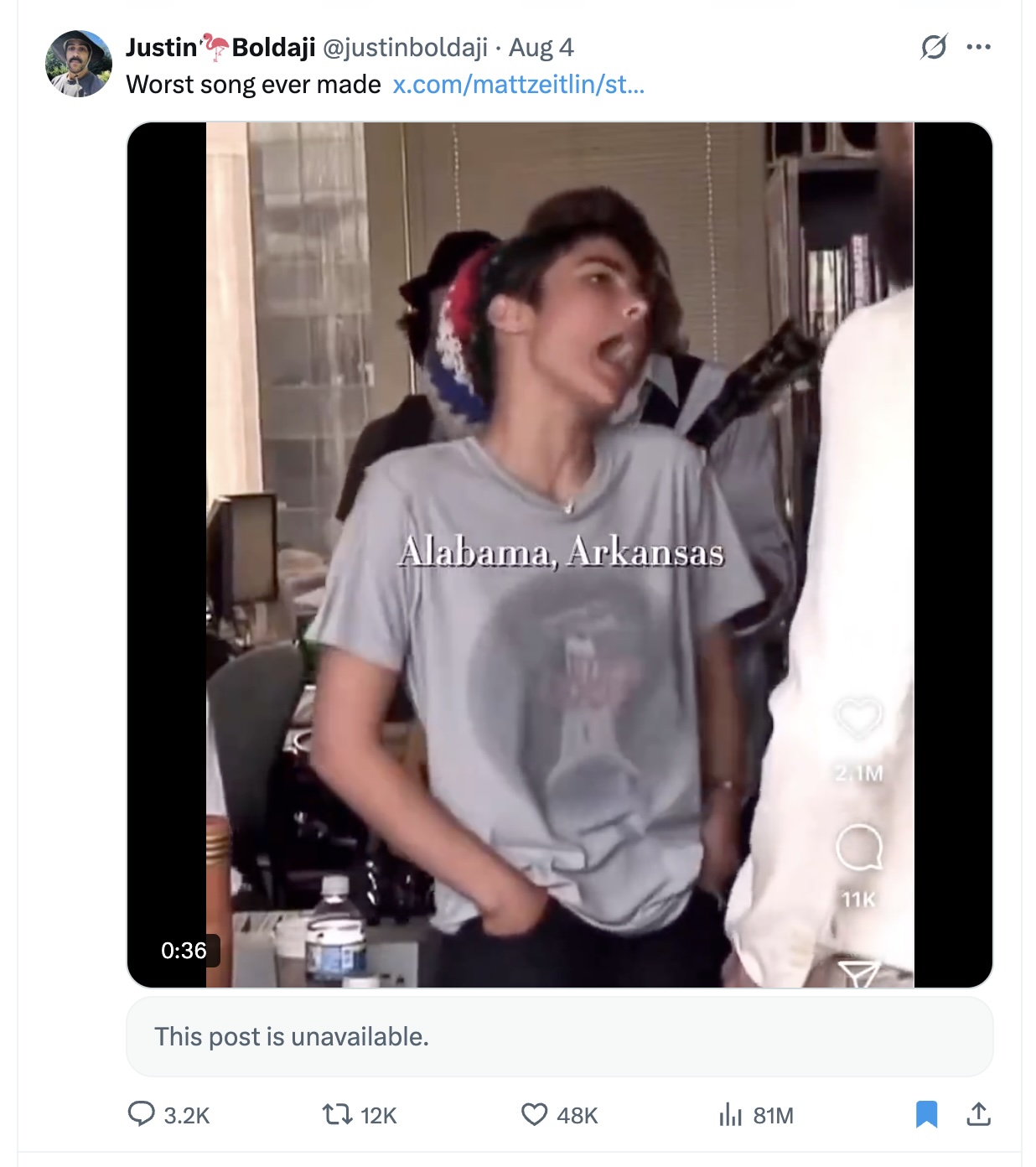
One song in particular struck the deepest nerve in the collective consciousness and that was “Home” by Edward Sharpe & The Magnetic Zeros. But the vocals of Jade Castrianos are what make the song what it is. You (probably?) know it. It’s the one that goes:


Alabama, Arkansas, I do love Ma and Pa


The most popular take I saw about this song this week is that it in fact is the “worst song ever made.” The enthusiastic responses to this take spread across the algorithm with a vengeance.


“Straight up Baby Shark for adults.” “Disgusting.” “Music to buy Axe bodyspray to.” 


Those were just some of the posters chiming in with their agreement. 


I have to say, I was taken aback. “Home” is a fun song. An earworm that’s rattled around my brain since I can’t remember when. I truly don’t understand the hate.


Even Pitchfork, that most pretentious corner of music criticism, had good things to say about “Home” way back in 2009. In its pan (4.1) of the album that “Home” was released on, Pitchfork calls the song “glaringly original” and “a jaunty duet” that justified the album’s existence.


Interestingly, all the hate on “Home” spawned a lot explorations about what was happening in the zeitgeist in the 2010s that fueled some of its hallmark features: stripped down exposed brick in restaurants along with edison bulbs and mason jars; the widespread adoption of twee branding; and the obsession with craft cocktails. 

 
I think the 2010s' stripped down designs and reclaimed wood was a reaction to the Y2K era’s obsession with technology and early 2000s maximalism. As a local business reporter in Richmond, it was obvious to me at the time that people and businesses were yearning for experiences that felt more “natural” and less wasteful. They wanted things to slow down and produce better quality. 


[Editor’s note: The algorithms we’re all now victims of also played a big role in making us feel like we were seeing exposed brick, edison bulbs, and mason jars at every new eatery at the time. There’s even a whole book about it, which I highly recommend.]


The best example I can think of is an advertising guy who opened an actual general store and soda fountain in 2016 in Church Hill in Richmond. He was literally selling cute, but functional, brooms, and was in coveralls when I interviewed him. 


Would you recommend this newsletter to your friends and family?


Do you or your company want to support Dogwood’s mission and showcase your products or services to an engaged audience of more than 35,000 subscribers at the same time?

Contact advertise@couriernewsroom.com for more information.


This email is written by Michael O'Connor, a reporter at Dogwood.
Have a question or comment? Reply back to this email!

FacebookInstagramTikTok TwitterWeb Site

Copyright ©2025 Courier Newsroom. All rights reserved.

You are receiving this email because you opted in via our website.


Our mailing address is:
Courier Newsroom
611 Pennsylvania Ave SE
Washington, DC 20003-4303


Want to change how you receive these emails?
You can update your preferences or unsubscribe  from this list.